


TE Trey McBride signed a 4 year, $76MM contract extension with the Arizona Cardinals this off-season. The payday is well deserved – the man’s an animal. The structure is classic, with some prototypical modern contract frameworks mixed in. The extension is very unique as a one-of-a-kind inflection point for the tight end market. Trey McBride’s extension is a fascinating case study into the surprising off-the-field factors that can influence a contract.
Entering the League
Coming out of Colorado State, Trey McBride was a multi-year starter, a PFF and Multi-award recognized talent, with a ~80th percentile athletic score and a ~93rd percentile production score.
After a slow rookie year buried behind Zach Ertz, Trey McBride exploded halfway through his sophomore season, ultimately finishing the year with 825 receiving yards, 81 receptions, and boasting an impressive 76% catch rate, albeit with a sub-par 3 touchdowns.
His success continued in his 3rd, and most recent, NFL season. McBride kept pace with his 2023 numbers, finishing with 1,146 yards, a ridiculous 111 receptions, and continuing with a 76% catch rate. The touchdown woes did continue, with a miraculously low 3 total scores on the year.
The Extension
After his 3rd year, McBride became eligible for a contract extension. With multiple years of sustained success on his resume and one year left on his rookie contract, it appears McBride and the Cardinals both had a vested interest in getting a deal signed.
The deal feels very classic in a lot of ways. You’ve got the large $16.5MM signing bonus taking up a third to half of the guaranteed money.
The contract has all the “trinkets” too. Workout bonuses, roster/gm active bonuses, a roster bonus in the last year of the deal, and even some escalations which should eventually guarantee his 2027 season salary.

The option bonus in 2026 is a fun little modern twist. From what I see here, they took what would be 2026 salary and elected to spread out a portion of its’ cap hit ($5.625MM) over 3 years. For Trey McBride, 2026 and 2027 are the same, $7.5MM just comes from a bonus. For the Cardinals, 2026 is a lighter year for Trey McBride’s cap hit.
I see a few non-guaranteed years at the end of the deal. This is a classic NFL lesson that it took me a while to get used to. Remember, only the guarantees are real.
The deal functions as a 2 year, $43MM extension, where the Cardinals have an option to cut McBride in 2028 in exchange for a $10MM dead cap hit. The average yearly compensation is $2MM or so higher than the top of the market, with (effectively) the same yearly guarantees as the other top of the market deals.
McBride’s Niche in the Marketplace
Before we go much further, let’s look at the TE market. Of the established guys, Travis Kelce has aged out of that conversation, George Kittle, Mark Andrews, and Dallas Goedert are still kicking on the last year of their second contracts. David Njoku, Cole Kmet, and Pat Freiermuth, are all early into 2nd contracts and not quite commanding top of the market money. None of the upcoming 3rd year guys profile as market breakers like McBride, Sam Laporta took a step back in the pecking order, Kincaid had an injury-riddled season, and Mayer got usurped by Brock Bowers, who’s 2 years from his payday.
Trey McBride’s extension is quite fascinating because, the way I see it, he has one true peer. We don’t see anyone else who’s obviously going to reset the market next year. We didn’t see a big tight end extension last year. The top-of-the-line guys are all much closer to their 3rd deals than the start of their 2nd. Except for T.J. Hockenson.
Hockenson is the most recent tight end to “reset the market.” A few years after being drafted in the first round by the Lions, he was traded to the Vikings, essentially in exchange for a 2nd round pick. Hockenson was halfway through the 4th year of his contract, with one full year remaining, his 5th year option which the Lions exercised.
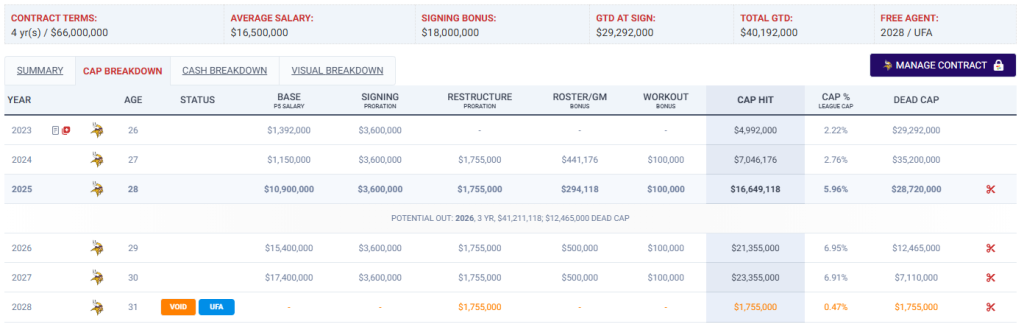
In 2023, before his 5th season, the Vikings and Hockenson reached an agreement for a 4 year, $68.5MM extension. Effectively, it is a 2 year, $42.5MM extension, where the Vikings have an option to cut Hockenson in 2026 in exchange for a $12MM dead cap hit.
Does that sound familiar to anyone?
The trinkets are a little different in value, but honestly? It’s the same deal, just 2 years later. Just add 2 years to the Hockenson deal figures, and you have McBride’s. And that is so, so, fascinating. Much like McBride, Hockenson was a highly drafted and productive player, with one year left on his contract, who reset the market with his extension. The guaranteed money structure makes the contracts effectively the same. McBride has relatively higher money allocated to non-guaranteed years, which changes the AAV.

Funnily enough, Hockenson also has a bonus/restructure proration nearly identical to McBride’s. 2024 salary was converted to an option bonus and prorated, much like how McBride’s 2026 salary was converted to an option bonus and prorated. Hockenson’s was in a restructure, but McBride’s was built in at signing. The only difference is an extra year of proration in Hock’s deal via. a void year.
Other Context
There are some other signals we can factor in that provide more context.
Hockenson had the “you just traded for me” leverage. The Vikings can’t trade a 2nd for this guy, let him play his 5th year option, then let him walk.
Hockenson had 1st round draft capital, 8th overall. We all know how the league respects its’ draft capital. He had access to a 5th year option, which he was offered, and he got an extra year to play before he hit the market.
Hockenson had a messier, albeit still very strong production profile. Now granted, all situations are different and should be analyzed as such. With that said, Hockenson’s sophomore year was spent with a full year as a starter, and resulted in comparable production to McBride (fewer yards, more TDs, but it took more games). His 3rd year, he kept decent pace, but missed time due to injury, compiling 854 receiving yards, 61 receptions, and 4 TDs over 12 games. His 4th season, the pre-extension and split-team season, he did impress, with 86 receptions, 914 yards, and 6 TDs.
My Thesis
So when we look at % of cap at year of signing… Hockenson was paid $16.5MM AAV in a cap environment of ~$225MM, commanding 7.3% of the cap at extension, with $42.5MM effectively guaranteed to hit his account. McBride inked $19MM AAV in an environment of $280MM cap, commanding 6.8% of the cap at extension, with $43MM effectively guaranteed to hit his account.
I think this grades out as a great deal for the Cardinals.
I’m not an agent, I was not at the table, I was not in the negotiating room. With that being said, I believe there’s an argument to be made that McBride could have pushed for a little more. Don’t get it twisted. This is a great deal that is a win for both sides, and I’m excited to watch McBride ball out in the 2026 season.